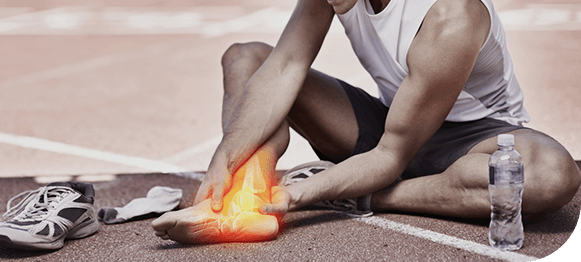
Orthopaedic trauma care focuses on treating injuries caused by accidents, falls, or high-impact events. This includes damage to bones, joints, muscles, and ligaments that require prompt evaluation and expert management to restore function and mobility.

Shoulder
Anatomy
The shoulder is the most flexible joint in the body that enables a wide range of movements including forward flexion, abduction, adduction, external rotation, internal rotation, and 360-degree circumduction. Thus, the shoulder joint is considered the most insecure joint of the body, but the support of ligaments, muscles, and tendons function to provide the required stability. Know More
Conditions
- Clavicle Fracture
- Scapula Fracture
- Acromion Fracture
- Glenoid Fracture
- Proximal Humerus Fracture
- Humeral Shaft Fracture
- Shoulder Dislocation
- Acromioclavicular Dislocation
- Sternoclavicular Dislocation
Procedures
Nonoperative Care
Videos

Elbow
Anatomy
The elbow is a complex joint formed by the articulation of three bones – the humerus, radius, and ulnar. The elbow joint helps in bending or straightening of the arm to 180 degrees and lifting or moving objects. Know More
Conditions
- Distal Humerus Fracture
- Radial Head Fracture
- Radius Fracture
- Ulnar Fracture
- Olecranon Fracture
- Elbow Dislocation
- Radial Head Dislocation
- Heterotopic Ossification
Procedures
Nonoperative Care
Videos
Hip
Anatomy
The hip joint is the largest weight-bearing joint in the human body. It is also referred to as a ball and socket joint and is surrounded by muscles, ligaments, and tendons. The thigh bone or femur and the pelvis join to form the hip joint. Know More
Conditions
- Pelvis Fracture
- Acetabular Fracture
- Femoral Head Fracture
- Femoral Neck Fracture
- Intertrochanteric Fracture
- Subtrochanteric Fracture
- Hip Dislocation
- Stress Fracture
- Hip Pain
- Hip Bursitis
- Hamstring Injuries
- Heterotopic Ossification
Procedures
- Open Reduction Internal Fixation
- Percutaneous Reduction Internal Fixation
- Hip Hemiarthroplasty
- Hamstring Repair
- Heterotopic Bone Excision
Nonoperative Care
Videos
Knee
Anatomy
The knee is a complex joint made up of different structures - bones, tendons, ligaments, and muscles. They all work together to maintain the knee’s normal function and provide stability to the knee during movement. Know More
Conditions
- Distal Femur Fracture
- Patella Fracture
- Tibial Plateau Fracture
- Fibular Fracture
- Quadriceps Tendon Rupture
- Patellar Tendon Rupture
- Knee Stiffness
- Knee Contracture
- Tibial Stress Fracture
Procedures
Nonoperative Care
Videos

Ankle
Anatomy
The foot and ankle form complex joints that are involved in movement and providing stability and balance to the body. The foot and ankle consist of 26 bones, 33 joints, and many muscles, tendons, and ligaments. Know More
Conditions
- Ankle Sprain
- Ankle Fracture
- Ankle Arthritis
- Talus Fracture
- Calcaneus Fracture
- Avascular Necrosis
- Bone Spur
- Achilles Tendon Rupture
Procedures
- Open Reduction Internal Fixation
- Percutaneous Reduction Internal Fixation
- Ankle Arthrodesis
- Distraction Arthroplasty
Nonoperative Care
Videos
Foot
Anatomy
The foot and ankle form complex joints that are involved in movement and providing stability and balance to the body. The foot and ankle consist of 26 bones, 33 joints, and many muscles, tendons, and ligaments. Know More
Conditions
- Toe Fracture
- Metatarsal Fracture
- Cuboid Fracture
- Navicular Fracture
- Ankle Dislocation
- Chopart Dislocation
- Lisfranc Injury