Shower with the External Fixator
After you have worn your fixator for 7 to 14 days, and after instructed by the doctor, you may shower while wearing your fixator. While in the shower, gently clean your fixator with soap and water. Be sure to rinse the fixator well. Afterwards, dry the fixator thoroughly with a clean towel. Then clean the pin sites as follows:
Pin Site Care After Showering
Clean the pins once a day unless your orthopaedic care team gives you other instructions. If germs from one pin site get onto another pin site, this can cause infection. So don't let anything that touches one pin touch another. This includes gloves, gauze, tweezers, cotton swabs, and anything else that touches the pins.
To clean the pins:
- Remove any crusting around the pins using a cotton swab or Q-tip. Use a separate swab for each pin.
- Remove any clear or yellow drainage with a cotton swab. Use a separate swab for each pin
- If needed, use a squeeze bottle to squirt sterile saline on each pin and surrounding skin. Do not touch the tip of the bottle to the pins or skin.
- Dry around each pin using sterile gauze or cotton swabs. Use a clean gauze or swab for each pin.
- DO NOT USE ANTIBIOTIC OINTMENT ON THE PIN SITES. This will only plug the pin site holes. In addition, you should not put any creams or powders near the pin sites.
What Are the Signs of a Pin Infection?
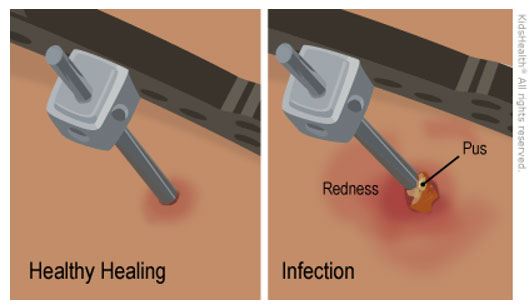
It is normal for the pin sites to be pink in appearance or have a slight red discoloration to the skin. It is also normal for them to drain a clear to yellow (looks like honey) or blood-tinged fluid on occasion. These are not signs of an infection.
However, redness, pain, warmth, swelling, pus (looks like yogurt) or more drainage from any of the pin sites can be signs that you have a pin infection. A fever higher than 101°F (38.5°C) also can be a sign of a pin infection.
It is important to keep in mind that pin site infections are a part of wearing an external fixator. It is not unusual for a patient to have at least one pin site infection. It is not necessarily a reflection on you or your care of the fixator. The important part of pin site infections is that they are easily treatable and managed when spotted early and addressed swiftly.
When Should I Call the Doctor?
Call your surgeon right away if you have signs of a pin infection. You may need antibiotics to make the infection go away.