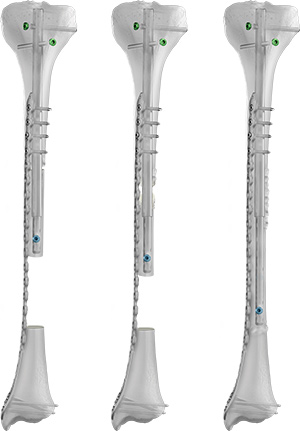
What is Plate Assisted Bone Segment Transport?
Plate assisted bone segment transport (PABST) is a surgical technique used to treat long bone defects. Unlike external fixation and cable transport methods, PABST offers an “all-inside” solution that combines a locking plate and a motorized lengthening nail. All implants are placed underneath the skin or muscle against the bone.
How Does Plate Assisted Bone Segment Transport Work?
Plate assisted bone segment transport for a bone defect works by gradually moving a healthy bone segment to fill a defect or gap by controlled distraction osteogenesis. A locking plate is placed across the defect and secured to the bone segments above and below the problem area. A bone cut (osteotomy) is made to create a healthy segment of moving bone. A motorized medullary nail is placed and attached to the segment of moving bone (transport segment) and one side of the healthy bone. The nail guides the transport of a bone segment, allowing the segment to slowly move across the defect at a controlled rate (usually about 1 mm per day). This solution eliminates the need for bulky external fixators, using the plate to maintain limb alignment and stability while the nail transports a healthy bone segment to fill the defect. As the segment advances, new bone forms behind it through distraction osteogenesis. The plate acts as a “track” for stability, maintaining proper alignment and preventing angulation, rotation, or shortening during transport.
When is Plate Assisted Bone Segment Transport Indicated?
Plate assisted bone segment transport for a bone defect is typically indicated in:
- Large segmental bone defects (commonly >3–5 cm)
- Post-traumatic bone loss after severe fractures
- Infected nonunion (osteomyelitis) requiring bone resection
- Bone defects after tumor removal
- Failed previous fixation or reconstruction procedures