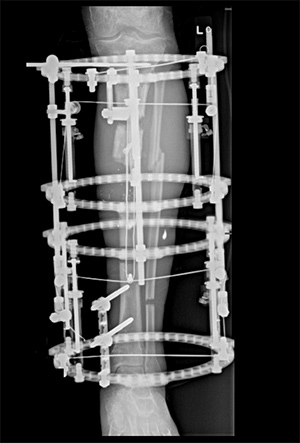
What Is Cable Transport?
Cable transport is an advanced limb reconstruction technique used to treat significant bone loss, nonunion fractures, and complex skeletal defects. It is a form of bone transport procedure in which a segment of healthy bone is gradually moved across a defect using a specialized cable system attached to an external fixation frame.
As the bone segment is slowly advanced, new bone forms in the space behind it through a process called distraction osteogenesis. This method allows surgeons to regenerate living bone tissue while restoring length, alignment, and structural stability without relying solely on large bone grafts.
When Is Cable Transport Recommended?
Cable transport is typically recommended for patients with complex bone defects that cannot heal with standard surgical fixation alone. It may be used in the following situations:
- Large segmental bone loss due to trauma
- Infected nonunion fractures
- Bone defects following tumor removal
- Severe open fractures
- Limb shortening from prior injury
- Failed previous fracture surgeries
- Chronic osteomyelitis with bone destruction
Your orthopedic surgeon will evaluate imaging studies and overall health to determine if cable transport is appropriate.
What Does Preparation for Cable Transport Involve?
Preparation includes a detailed physical examination and imaging studies such as X-rays or CT scans to assess the size and location of the bone defect. Infection must be carefully evaluated and treated before reconstruction begins.
Preoperative lab testing and medical clearance may be required. Smoking cessation is strongly recommended, as smoking impairs bone healing. Your surgeon will also review frame management, daily adjustments, and expected recovery timelines.
How Is Cable Transport Performed?
The procedure is performed under anesthesia. After removing any damaged or infected bone, the surgeon applies an external fixation frame to stabilize the limb. A controlled surgical cut (osteotomy) is made in a healthy portion of bone to create a movable segment.
A cable mechanism is connected to gradually pull the bone segment across the defect at a carefully controlled rate. As the segment advances, new bone forms in the gap behind it. Adjustments are typically made daily according to a precise schedule until the defect is filled.
What to Expect During Recovery After Cable Transport?
Recovery can take several months, depending on the size of the defect. Patients may begin partial weight-bearing as directed by their surgeon. Regular follow-up visits are necessary to monitor bone formation and alignment.
Physical therapy helps maintain joint motion and muscle strength. Once sufficient healing has occurred, the external frame is removed, and continued rehabilitation supports full recovery.
What Are the Risks and Complications of Cable Transport?
As with any complex orthopedic procedure, potential risks and complications may include:
- Pin site infections
- Pain or swelling
- Delayed bone formation
- Joint stiffness
- Nerve or blood vessel irritation
- Recurrent infection
- Mechanical problems with the fixation device
Careful monitoring and adherence to postoperative instructions reduce these risks.
What Are the Benefits of Cable Transport?
Cable transport offers several important advantages for complex bone reconstruction, including:
- Regenerates natural, living bone
- Restores limb length and alignment
- Treats large bone defects without extensive grafting
- Addresses infected nonunions effectively
- Provides stable fixation during healing
- Preserves surrounding soft tissue
When performed by an experienced orthopedic surgeon, cable transport can successfully restore bone continuity and function in challenging cases.